6G-Cloud was represented at the 12th IEEE International Conference on Network Softwarization – IEEE NetSoft 2026, held in Berlin, Germany, from 29 June to 3 July 2026. During the conference, project partners presented two scientific contributions addressing key challenges for future 6G networks: energy-aware AI inference and intelligent RAN controller orchestration.
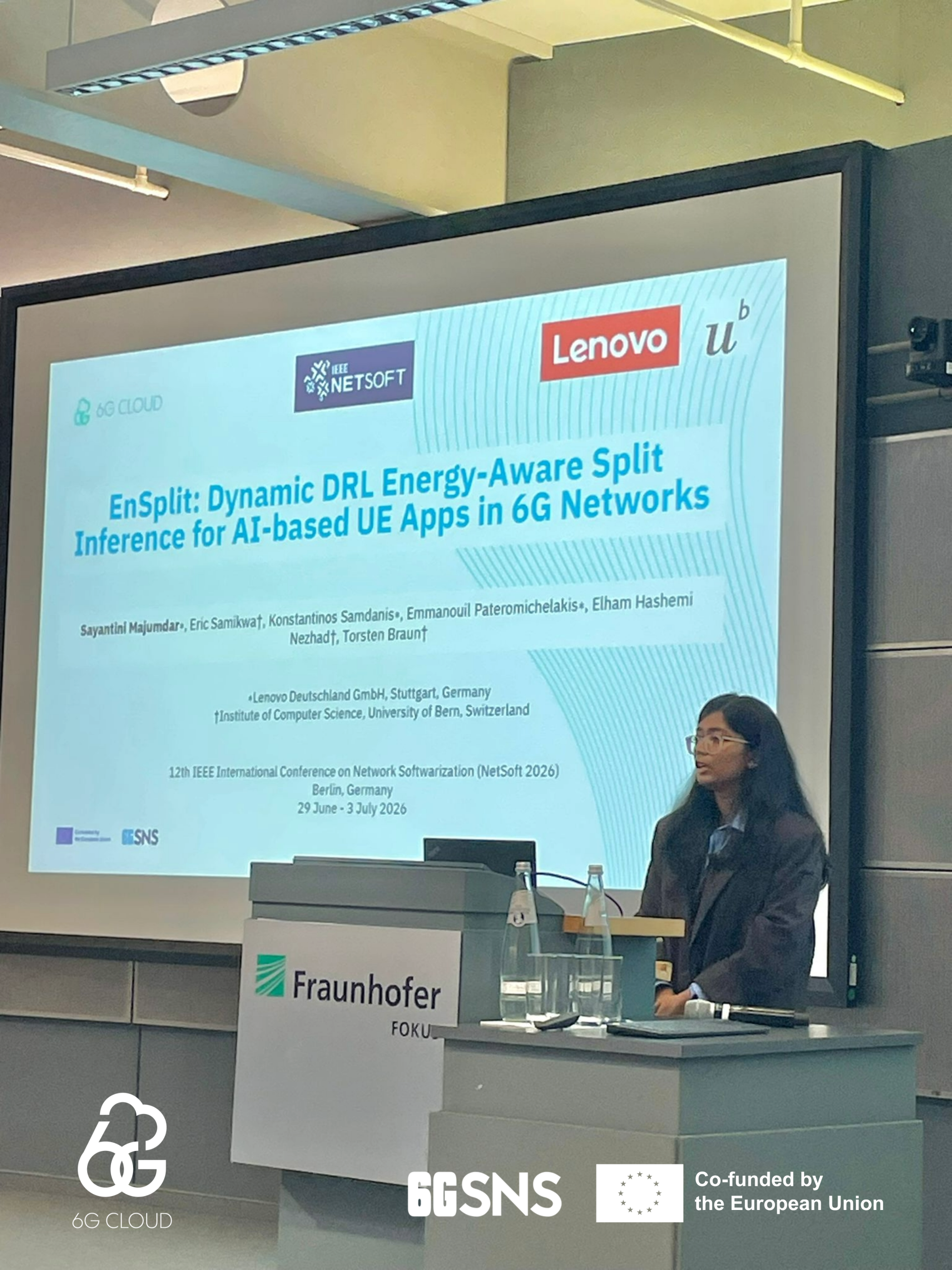
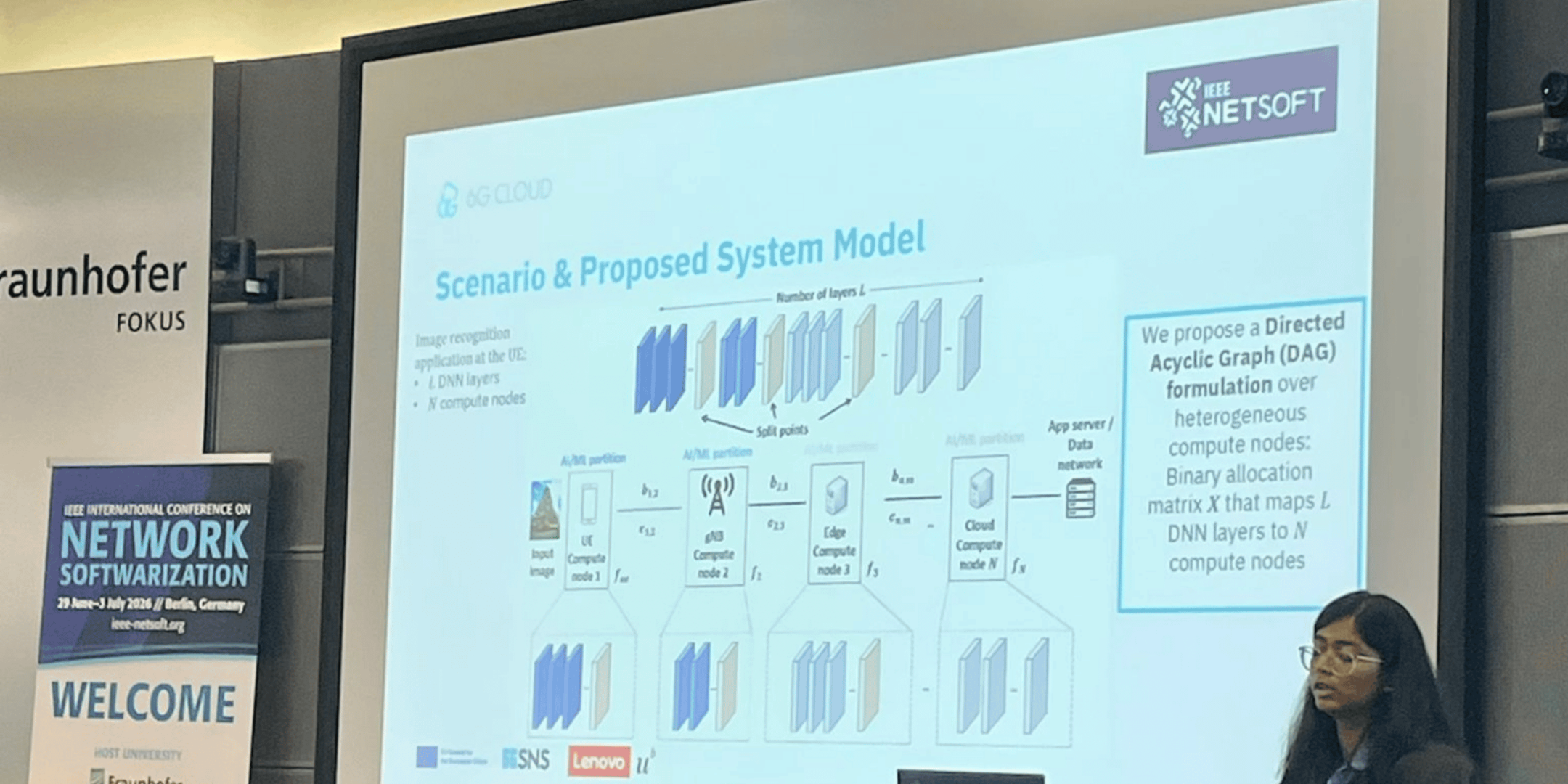
On 1 July 2026, Sayantini Majumdar (Lenovo) presented the publication “EnSplit: Dynamic DRL Energy-Aware Split Inference for AI-based UE Apps in 6G Networks.” The work focuses on how AI/ML inference can be dynamically split between user equipment and edge/cloud compute nodes in 6G networks, addressing challenges related to device energy consumption, latency, offloading costs, and privacy constraints.
The proposed EnSplit framework uses Deep Reinforcement Learning to optimise DNN split inference under energy-credit constraints, enabling more sustainable and adaptive energy management for AI-based applications in future 6G environments. The results presented showed that EnSplit can achieve near-optimal performance, reducing inference latency by up to 47% and user equipment energy consumption by up to 80% compared to baseline approaches.
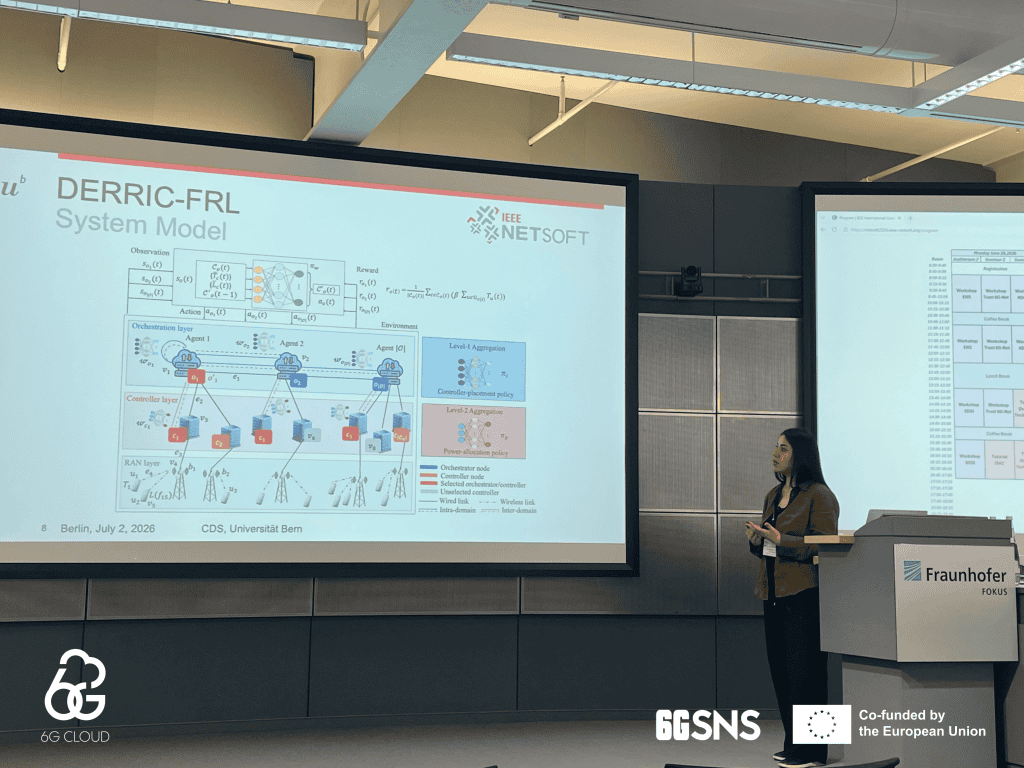
On 2 July 2026, Elham Hashemi Nezhad, from Universität Bern, presented “Decentralized Federated Multi-Agent Reinforcement Learning for RAN Controller Orchestration in 6G.” The presentation introduced DERRIC-FRL, a framework focused on decentralized federated multi-agent reinforcement learning for RAN controller orchestration in 6G networks.
This work addresses the need to preserve data privacy during reinforcement learning actions, reduce communication costs in intra- and inter-domain connections, and improve learning policies and network performance. The presentation also explored how Federated Learning can support decentralized RIC orchestration under privacy and data-sharing constraints, as well as how selective participation of RAN controllers can reduce communication costs while maintaining network performance in dynamic environments.
Together, these two presentations demonstrate 6G-Cloud’s contribution to the development of intelligent, adaptive, privacy-aware, and energy-efficient 6G network architectures. They also reflect the project’s work on integrating AI/ML tools, cloud-native network functions, cloud continuum resource management, and scalable orchestration mechanisms for future 6G systems.
6G-Cloud congratulates Sayantini Majumdar, Elham Hashemi Nezhad, and all contributing partners for presenting these research outcomes at IEEE NetSoft 2026 and sharing the project’s progress with the international network softwarization community.